Have you ever wondered how Filipinos transported goods before trucks existed?
Unlike many countries connected by land, the Philippines is an archipelago made up of more than 7,600 islands. For centuries, moving products wasn’t simply about convenience; it was essential for survival, trade, and economic growth.
Every generation developed better ways to transport food, construction materials, livestock, and other necessities. Today’s logistics industry didn’t appear overnight. It evolved over hundreds of years.
Pre-Colonial Philippines: The Country’s First Logistics Network
Long before paved roads existed, Filipinos had already established thriving trade routes. Without trucks or railways, communities depended on natural transportation routes.
On Land
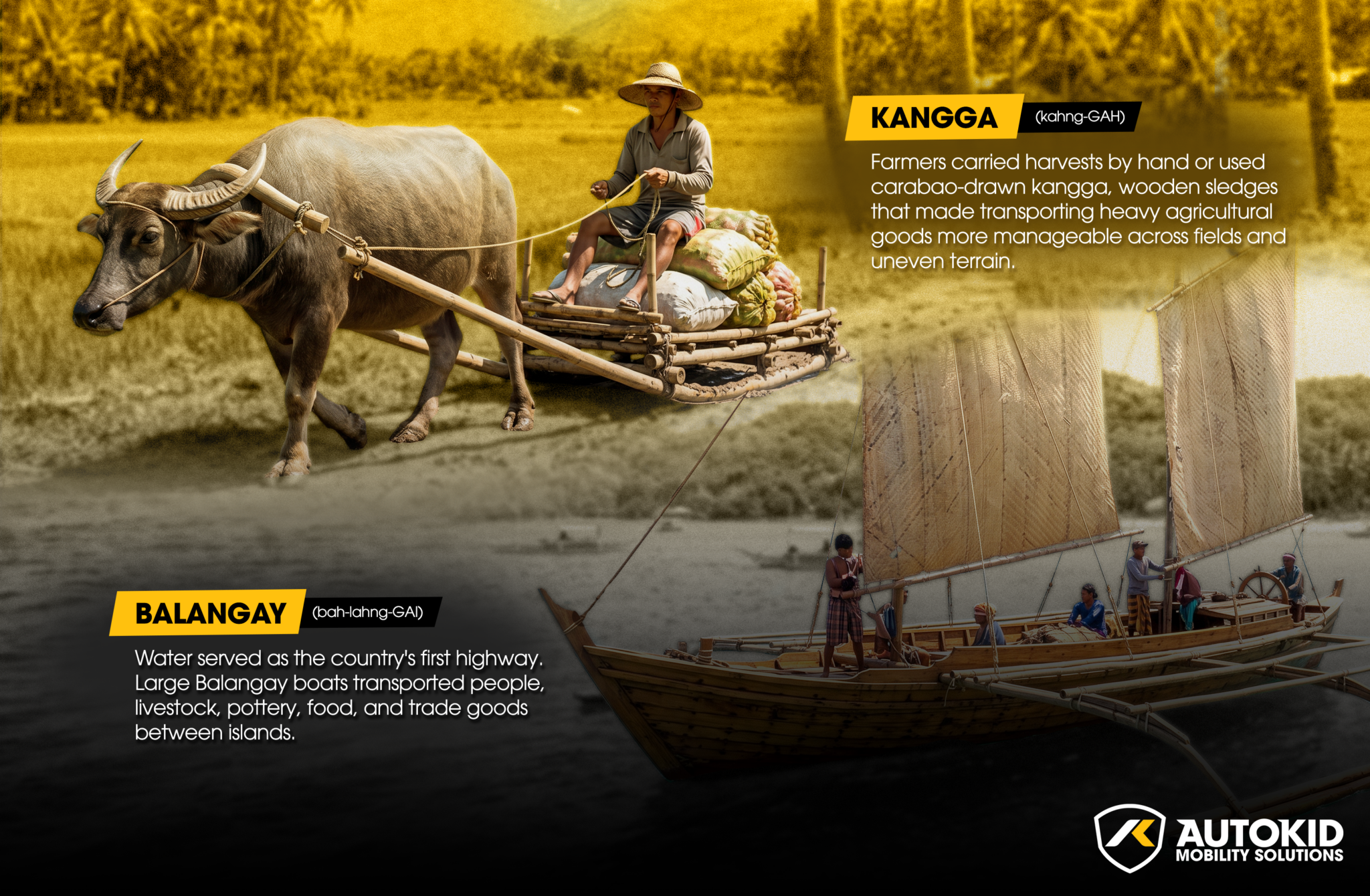
Farmers carried harvests by hand or used carabao-drawn kangga, wooden sledges that made transporting heavy agricultural goods more manageable across fields and uneven terrain.
Across the Sea
Archaeological discoveries of Balangay boats in Butuan suggest that ancient Filipinos were already engaged in sophisticated maritime trade long before Spanish colonization.
Water served as the country’s first highway. Large Balangay boats transported people, livestock, pottery, food, and trade goods between islands. Know more about it here.
These vessels also connected Philippine communities with neighboring kingdoms in Southeast Asia, allowing commerce to flourish centuries before modern ports and container ships. In many ways, the Balangay was the Philippines’ first cargo vessel.
Spanish Colonial Period (1565–1898): Connecting the Philippines to the World

The Manila–Acapulco Galleon Trade (1565–1815)
For approximately 250 years, giant galleons crossed the Pacific Ocean between Manila and Acapulco, Mexico. These ships carried silk, porcelain, spices, and other valuable Asian goods while returning with silver from the Americas. This trade route transformed Manila into one of Asia’s most significant trading ports. Read more about it here.
The Rise of the Kalesa
As towns expanded, horse-drawn kalesas became one of the most common forms of transportation. While primarily known for carrying passengers, they also helped move goods through growing communities. Read more about it here.
Steamships Modernize Maritime Transport
By the mid-1800s, steam-powered ships began replacing traditional sailing vessels. Because they no longer depended solely on wind, merchants could move larger quantities of cargo more quickly and predictably. This significantly improved trade between Manila and international ports.
Manila’s Rivers Were Once Major Highways
Before today’s road network existed, Manila’s rivers and esteros were among the city’s busiest transportation routes. Boats regularly carried people and goods throughout the capital, demonstrating that efficient logistics has always depended on choosing the best available transport infrastructure. Read more about it here.
The Manila–Dagupan Railroad: Faster Cargo Movement
One of the most important transportation developments during the Spanish period was the construction of the Manila–Dagupan Railroad, completed in 1892. Read more about it here.
The railway connected agricultural provinces in Central Luzon to Manila, making it easier to transport rice, sugar, and other farm products.
Instead of relying entirely on slower overland methods, producers could move larger volumes of goods more efficiently. It was an early example of how transportation infrastructure directly supports economic growth.
The Arrival of Commercial Trucks in the Philippines

The early 1900s marked the beginning of modern road freight in the Philippines with the introduction of commercial motor trucks during the American colonial period. Initially brought into the country by the U.S. Army Signal Corps and private American and European importers, these vehicles were used for military operations, construction, agriculture, and industrial transport. Read more about it here.
Among the early commercial truck fleets were the Grawbosky trucks, while pioneer transport companies such as ALATCO, later known as Philtranco after its founding in 1914, helped expand road-based passenger and cargo transportation across the country. Read more about it here.
As road networks improved, commercial trucks enabled businesses to transport heavier loads farther and faster than ever before. This transformation laid the foundation for the modern logistics industry that continues to keep Philippine businesses moving today.
Transportation Continued to Evolve

The early 1900s also saw the introduction of aviation through exhibition flights in Manila, while buses and private automobiles gradually became more common.
Following World War II, surplus military jeeps were transformed into public utility jeepneys—an innovation that eventually became one of the country’s most recognizable transportation icons.
Meanwhile, logistics continued expanding. Transportation hubs such as Dangwa helped distribute vegetables and flowers from Benguet to Metro Manila, showing how better transportation networks could strengthen regional industries and create entirely new commercial centers. Read more about it here.
Modern Logistics: One Truck No Longer Fits Every Job

Today’s logistics industry is far more specialized than it was decades ago. Businesses now choose commercial vehicles based on the type of cargo they transport. Some of the most common truck applications include:
- FB Body Trucks for general cargo and business deliveries
- Dropside Trucks for construction supplies and hardware materials
- Dump Trucks for infrastructure, mining, and earthmoving projects
- Aluminum Vans for secure enclosed transportation
- Wingvans for high-volume distribution with faster loading and unloading
- Reefer Vans for transporting frozen food, fresh produce, pharmaceuticals, and other temperature-sensitive products
- Special Purpose Vehicles for emergency response, utilities, and government operations
Modern logistics isn’t simply about moving products. It’s about moving the right products using the right vehicle as efficiently as possible.
The Future of Transportation and Logistics in the Philippines

As technology continues to reshape the commercial vehicle industry, both public transportation and logistics are becoming smarter, more efficient, and more sustainable. Whether powered by electricity or advanced clean diesel engines, today’s modern buses and commercial trucks are designed with innovative features that improve operational efficiency, reduce costs, and deliver better mobility solutions.
From modern public transport fleets that provide safer and more comfortable commuting experiences to commercial vehicles that streamline deliveries and business operations, technology is transforming the way people and goods move across the country. Fleet management software, GPS tracking, telematics, intelligent safety systems, and fuel-efficient powertrains enable operators to optimize routes, improve vehicle performance, and enhance overall productivity.
As the industry continues to evolve, adopting modern commercial vehicle technologies—whether electric or diesel-powered—will play a vital role in building a more connected, efficient, and sustainable future for both transportation and logistics in the Philippines.
Keeping Philippine Businesses Moving Forward
From ancient trade routes to today’s commercial trucks, transportation has always been about moving people, goods, and opportunities forward.
At Autokid Mobility Solutions, we’re proud to continue that journey by helping businesses across the Philippines find the right commercial vehicles for their operations.
✔ Flexible financing options – designed to help you start without high upfront costs. Read more about it here.
✔ Insurance solutions – tailored to protect your units and your operations. Read more about it here.
✔ Comprehensive product demonstrations – so you fully understand every feature. Read more about it here.
✔ 5-star after-sales support – with trained mechanics, responsive teams, and ISO-certified service centres nationwide. Read more about it here.
✔ Parts Warehouse – ensuring year-round availability of quality parts, properly stored and maintained to keep your units running efficiently and reliably. Read more about it here.
✔ A wide inventory of brand-new, reliable, and all-weather-ready units.
✔ Special units like reefer vans and mobile solutions tailored to your operations.
✔ Strong partnerships with globally trusted brands such as Dongfeng & FAW, a reliable name in the Philippine market for over 15 years. Learn more about it here.
Partner with Autokid Mobility Solutions
🌐Visit Our Website: autokid.com.ph
📱Connect With Us on Social Media: Facebook | TikTok | Instagram
📞Give Us a Call: 0917-653-0000
Trusted by global brands. Chosen by Filipino businesses. Driven by partnerships that move the Philippines forward.
Frequently Asked Questions
What was the earliest form of transportation in the Philippines?
Before colonial rule, Filipinos transported goods by foot, using carabao-drawn sledges on land and Balangay boats for inter-island trade.
When were commercial trucks introduced in the Philippines?
Commercial motor trucks began appearing during the early American colonial period in the early 1900s, primarily supporting agriculture, construction, and industrial transport.
Why is logistics important in the Philippines?
Because the Philippines is an archipelago, efficient transportation is essential for moving food, medicine, construction materials, retail products, and other goods between islands and communities.
How has truck technology changed over time?
Commercial vehicles have evolved from basic cargo trucks into specialized fleets that include dump trucks, refrigerated trucks, wingvans, aluminum vans, electric trucks, and many other configurations designed for specific industries.
Disclaimer: This article is intended for educational and informational purposes only. It provides a general overview of the evolution of transportation and logistics in the Philippines using publicly available historical references. Some dates, events, and interpretations may differ across historical sources and researchers. Rather than serving as a definitive historical record, this article aims to illustrate how transportation has evolved over time and how these developments continue to shape today’s logistics industry.